The E30 M3 | The Car That Started It All
1986–1991 · S14 2.3L I4 · 192–238 hp
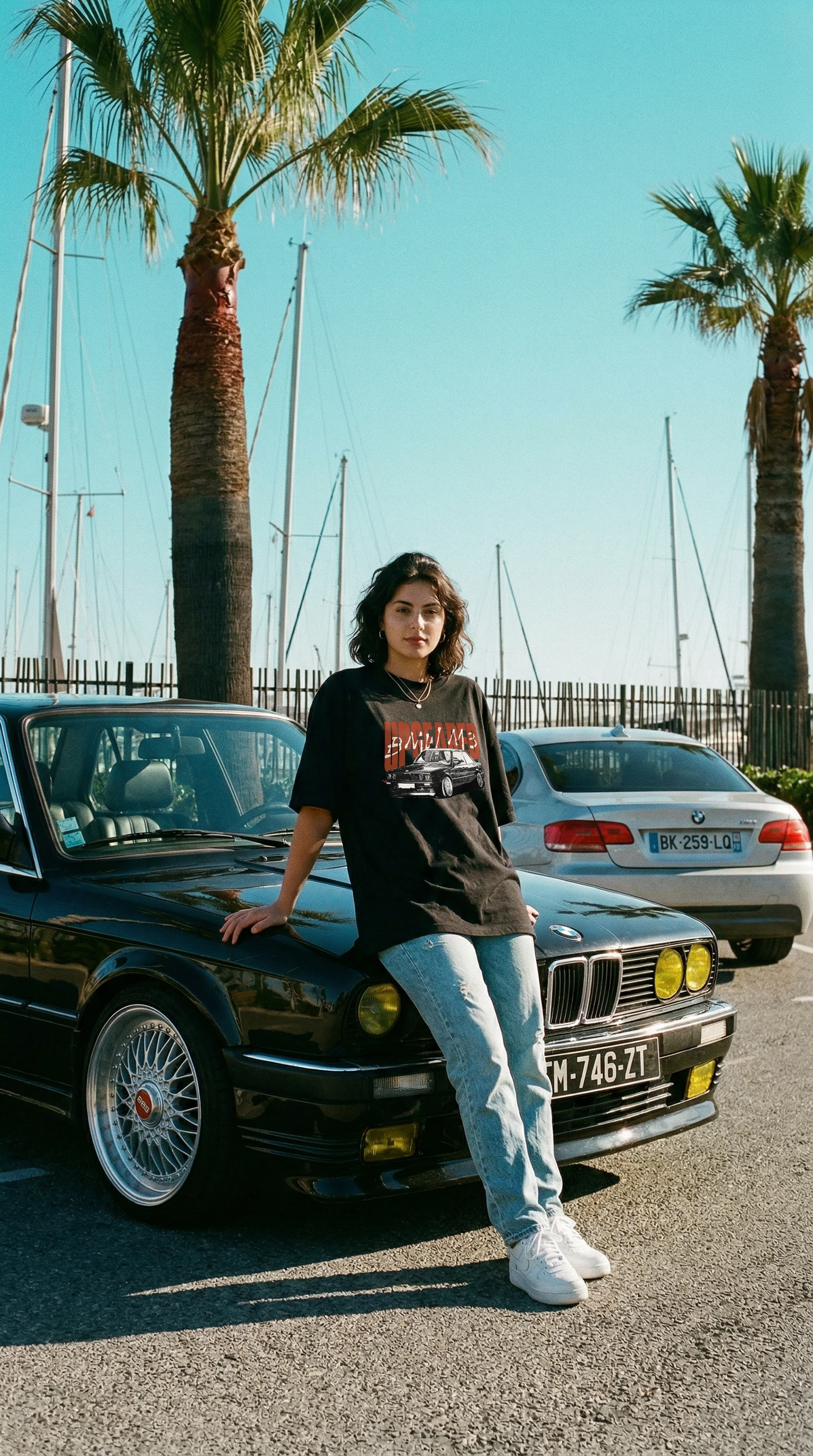
The M3 nameplate exists today because of a rule written for tin-top racing, not because BMW wanted to sell a fast 3 Series. In the mid-1980s, Group A touring car regulations required manufacturers to build at least 5,000 road-going units of any car they wanted to race. BMW didn't have a homologation special. So it built one.
That car was the E30 M3, produced from 1986 to 1991, and almost nothing about it was designed for comfort. The bodywork is boxier and more flared than a standard E30, not for looks but because the wider Group A track needed room for wider tires. The rear window sits at a steeper angle than any other E30, purely for aerodynamic reasons the racing program demanded. Even the trunk lid kicks up at the back edge. None of it was styling. All of it was homologation.
Under the hood sits the S14, a four-cylinder engine that looks like an odd choice next to the silky sixes BMW is known for, until you learn where its cylinder head came from. The S14 uses a shortened version of the S38 six-cylinder head, the same unit that powered the E28 M5 and M635CSi — and the S38 itself is an evolution of the M1 supercar's M88. BMW effectively took a race-bred six-cylinder head architecture, cut it down, and adapted it onto a smaller displacement four to keep weight down and revs up. It was never about outright power. It was about a chassis and engine combination built to be thrown into a corner at the limit, repeatedly, for hundreds of laps.
That's exactly what it did. The E30 M3 didn't just compete in Group A touring cars, it dominated. Its 1987 debut season swept championships across seven countries — WTCC, ETCC, DTM, and national titles from Italy to Japan — and at that year's Bathurst 1000 in Australia, a race usually owned by V8 muscle cars far larger and more powerful than a four-cylinder BMW sedan, the JPS Team M3 took a commanding 1-2 finish in class, beating cars with more than twice the displacement at their own game even without the outright win. The M3 won on balance and reliability, not brute force. That's the entire personality of the car in that season.
Four decades later, the E30 M3 occupies a strange position in car culture: it's simultaneously one of the most collected cars of its era and one of the most abused. For every numbers-matching, unmolested example commanding six figures at auction, there's another one that's been through three owners, a questionable repaint, and a turbo kit installed in someone's driveway. Both versions are equally part of the car's story. The E30 M3 was never precious when it was new. It was a homologation tool that happened to be brilliant, sold to people who mostly just drove it hard.
That's the part that gets lost when a car's values climb the way the E30 M3's have. What started as a roughly $30,000 used car a decade and a half ago now regularly clears well past that for clean examples, with rare Sport Evolution and Evolution II cars pushing into serious money. Parts that used to be a phone call away are now scavenged from other cars or reproduced by small specialty shops. The scarcity is real. So is the obsession with keeping a chassis number's history intact, the entire "numbers matching" fixation that collectors treat like scripture.
None of that polish is what earns the E30 M3 a place in Underground. This collection isn't about the concours-condition version of any car, it's about the garage version: hand-painted, halftone, built by someone who read the shop manual cover to cover before they ever turned a wrench. The E30 M3 fits because it was built the same way, a race car dressed up just enough to be street legal, sold to people who were going to find its limits whether BMW wanted them to or not.
The tee carries that same restraint. One car, one print, no reprint, the same rule the car itself was built under.
FAQ
What made the E30 M3 a homologation special?
Group A touring car rules required at least 5,000 road-going units of any car a manufacturer wanted to race, so BMW built the E30 M3 specifically to qualify — the flared bodywork and steeper rear window were both aerodynamic requirements from the racing program, not styling choices.
What engine does the E30 M3 use?
The S14, a four-cylinder using a shortened version of the S38 six-cylinder head — the same lineage that traces back to the M1 supercar's M88 engine — adapted onto a smaller displacement to keep weight down and revs up.
Why is the E30 M3 in the Underground collection?
Underground is built around the garage version of a car, not the concours one — the E30 M3 fits because it was a race car dressed up just enough to be street legal, sold to people who drove it hard.