The Diablo | Miami's Favorite Nightmare
1990–2001 · 5.7L V12 (later 6.0L) · 485–590 hp depending on variant (590 hp GTR track edition)
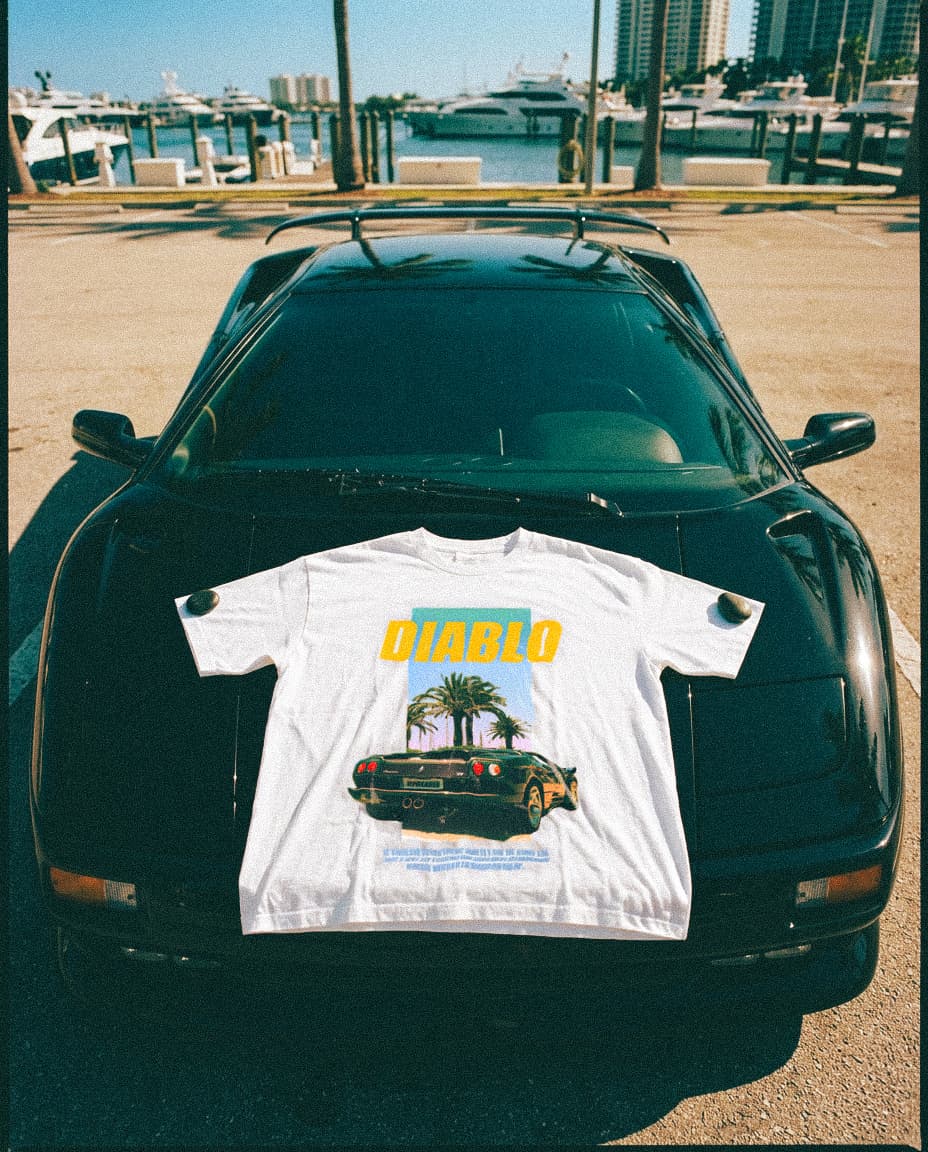
The Diablo is the direct successor to the Countach, which is a hard act to follow by design, since the Countach spent the better part of two decades being the single car everyone pictured when they pictured a supercar poster. Lamborghini needed the Diablo to hit just as hard. It launched in 1990, and for the next eleven years it was the Countach's replacement in every sense that mattered, including the wall space.
What most people don't know, or forget, is who actually owned Lamborghini when the Diablo went from concept to production. Chrysler acquired Lamborghini in 1987, under Lee Iacocca, and the company was still under American ownership when the Diablo launched three years later. That fact still gets argued about in enthusiast circles, an American automaker calling the shots on the successor to one of the most Italian cars ever built. It's a strange footnote for a brand whose entire identity is built on being uncompromisingly, aggressively Italian.
The design history is stranger still. Marcello Gandini, the same designer behind the Countach and the Miura, drew the original Diablo concept, and it was harder-edged and more aggressive than what actually reached production. Chrysler's in-house design team softened those lines before launch, rounding off the angles Gandini had drawn. He was reportedly unhappy enough about it that he later built his own version of his original vision anyway, on an entirely different car, the Cizeta-Moroder V16T, essentially releasing the Diablo he wanted to build under someone else's badge. The production Diablo, in other words, is a compromise between an Italian designer's original instinct and an American parent company's editorial hand. Somehow it still became one of the most iconic supercar silhouettes of its era.
None of that history is why the Diablo mattered to most people who grew up with it, though. It mattered because it was the poster car. Before internet car culture existed as a thing you could scroll through, before every teenager had a phone full of spec sheets and comparison videos, the Diablo was tape on a bedroom wall next to the Countach and the Testarossa, three names that defined an entire generation's idea of what "fast" and "impossible" looked like. It showed up in the earliest arcade racing games and the first console racers that took the genre seriously. Nobody who put a Diablo poster on their wall in the 90s was thinking about who owned Lamborghini that decade. They were thinking about the shape, the scissor doors, the sheer physical audacity of a car that looked like it was designed to be feared.
That's the register Vice is built on, and it's why the Diablo anchors the collection rather than sitting in Circuit next to the track-focused cars. Nobody obsesses over the Diablo's lap times. They obsess over the mood: neon at dusk, palm trees against a sunset, a car that exists to be looked at as much as driven. Vice isn't the technical collection. It's the aspirational one, and no car earns that word more honestly than the one that spent a decade on more bedroom walls than any car has a right to.
485 horsepower, a name that means "devil," and a design history complicated enough that even its own designer wasn't fully happy with the result. The Diablo didn't need to be perfect. It needed to be unforgettable, and it managed that with room to spare.
FAQ
Who designed the Lamborghini Diablo?
Marcello Gandini, the same designer behind the Countach and Miura, drew the original concept. Chrysler's in-house design team softened his harder-edged lines before the car reached production.
Was Lamborghini American-owned when the Diablo launched?
Yes — Chrysler acquired Lamborghini in 1987 under Lee Iacocca and still owned the company when the Diablo launched in 1990, an unusual footnote for a brand built on being uncompromisingly Italian.
How long was the Diablo in production?
From 1990 to 2001, as the direct successor to the Countach, across several variants including SE30 GT and Roadster derivatives.